

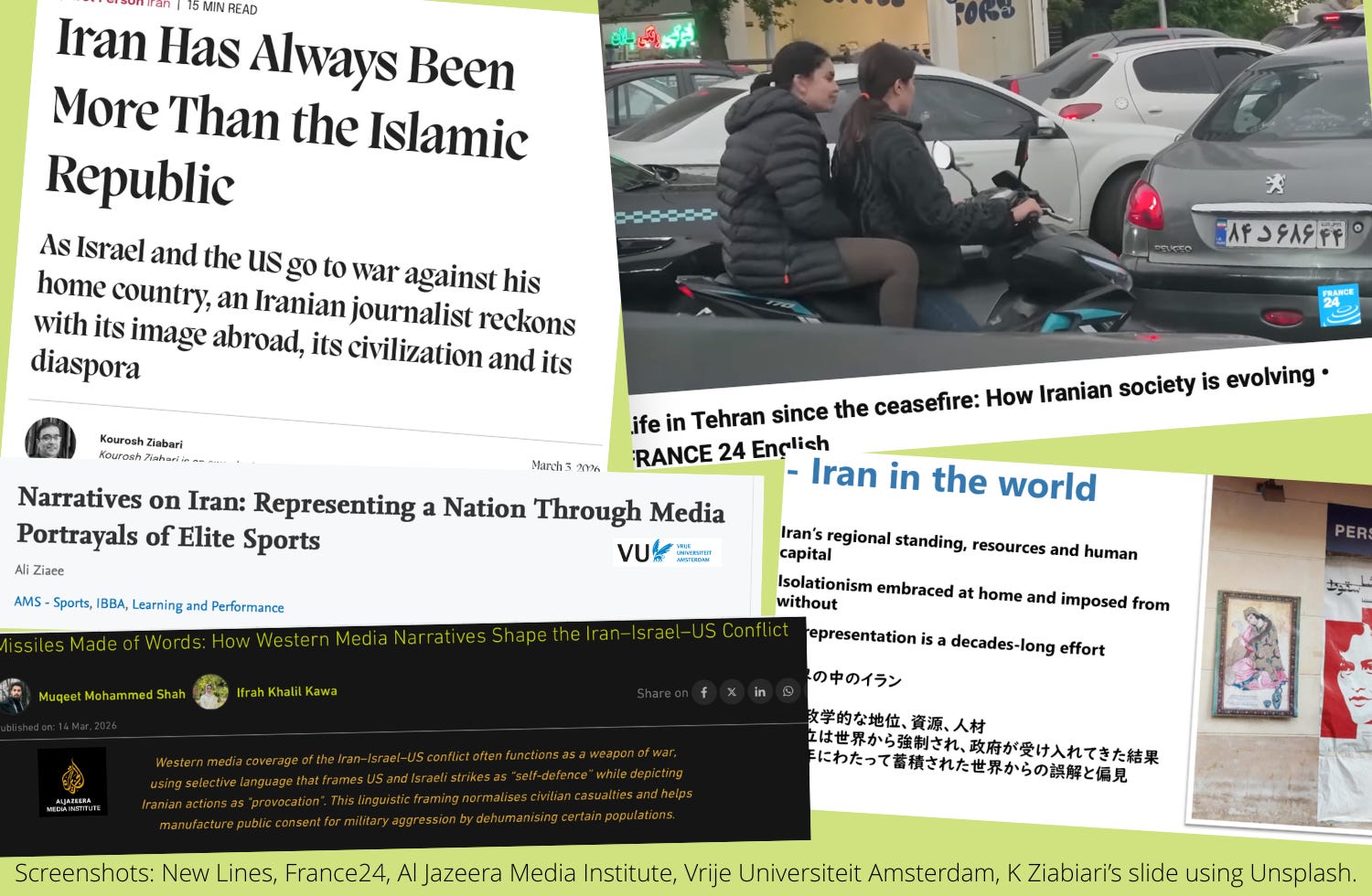
Kourosh Ziabari has no shortage of ways to describe the often-recycled portrayals of his home country, Iran, in the corporate western media – many of them amplified even more since the US-Israel war on the West Asian country in late February 2026.
In the interview below, the New York-based journalist and media studies researcher singles out narratives that perpetuate a “coagulation of stereotypes” about Iran in the western mainstream media. He talks about “simplistic” erasures of its diversity, “off-the-shelf cognitive frameworks” in reports, and narratives that “villainize” Iranian society.
A lack of curiosity in this age of AI does not help – and at times, there is just “lazy journalism” around Iran, points out the 36-year-old Kourosh, who holds a master’s degree from Columbia Journalism School.
All of these get in the way of seeing much of Iran and the nuances of its society beyond the almost assembly-line ‘branding’ in many of the mainstream media as troublesome and/or violent (which, one must add, is also often copied in reporting elsewhere, including in Southeast Asia and elsewhere in the non-Western world).
Indeed, Kourosh started an online discussion in May by talking – not about the war or the strategic positions of the Islamic republic – but about the things he said one needs to know about Iran. This conversation, attended by journalists and academics, was organised by NHK Japan, University of Tokyo and Waseda University*.
The pulse of Iran, Kourosh said, can be felt in its bustling cafes, among artists and students, in the huge contributions of Persian literature to the world and in the mix of Iranian, Islamic and Western flavours in its architecture. At the same time, this pulse is felt in the struggles of Iranians who push for change inside the country, in ways that are not always seen or understood outside, he explained.
In our email interview, he added: “The generic forms of reporting that are accessible in the mainstream media provide some degree of introduction: a country that is at odds with the West, a government that pursues a controversial nuclear programme and has a bleak human rights record, and a troubled economy that is beset by sanctions and bad governance.”
“But past a certain point, this is not introduction; rather, it’s indoctrination, because there is no way one of the oldest continuously sovereign states in the world can be described merely using three or four bullet points that have remained doggedly unchanged for decades,” said Ziabari, who began his journalism on the ‘Hatef’ weekly that his father had started in their hometown of Rasht in northern Iran over three decades ago.
“Like every other place, there is good, bad and ugly in Iran,” added Kourosh, who has won a number of awards for his reporting work.
In his March 2026 article for ‘New Lines’, Kourosh wrote about having nightmares that featured debates with the slain Supreme Leader Ayatollah Ali Khamenei and later, the silent “haunting” presence of Donald Trump.
And these days? He has been having a respite from “disturbing nightmares about two men with a markedly negative impact on their countries and the world”, Kourosh replied, but his dreams continue to be infused with politics. “These days, I dream about more recent developments, which apparently means journalists are destined to remain tied to the stories they cover, almost always.”
Below is our conversation.
What are one or two most common stereotypical or ‘misportrayals’ of Iran and/or Iranians in the western mainstream media (and some international agencies too) during the war in West Asia?
Kourosh: Misrepresentation of Iran in the corporate media is not a phenomenon to be solely scrutinized within the timeframe of the recent war and its aftermath. It is a much older pattern, and I have been tracking it since I came of age as a budding journalist in Iran in the mid-2000s.
It always struck me why the corporate media should be so inflexible in their coverage of Iran, scarcely going beyond a specific set of off-the-shelf cognitive frameworks to report on a country that has always been in the headlines, and often for similar reasons.
Although I acknowledge that the coagulation of stereotypes takes years and even decades, my understanding is that resistance to the revisiting of cliches when it comes to the coverage of Iran and the Middle East has been unreasonably deep-seated.
Also, one challenge surrounding the coverage of Iran is the unvarying lineup of pundits and commentators on whose wisdom we’ve been relying for so long to interpret Iranian affairs in media segments, interviews, and commentary, neglecting that they are repeating the same ideas all the time, just from different vantage points and using modified languages.
But common stereotypes about Iran are not difficult to recall given the significant space they occupy in our thought processes. The persistence of these misapprehensions gives the impression that we are deliberately being prevented from imagining an alternative.
This is, however, not exclusively a problem in reading Iran. What lies outside the geographical boundaries of the ‘West’ can easily end up being reduced to cursory, generic talking points. It’s both a problem of proximity in that we won’t necessarily care to delve into what is physically removed from us, and a problem of intellectual curiosity being in decline in the age of AI.
Among the most common questions about Iran involve the situation of women...
The most frequently-heard refrains about Iran include fallacious references to the educational attainment of its women, who despite a blend of patriarchic structures, remain one of the most highly-educated demographics in the Middle East.
We hear commentators and even journalists using unrefined, old tropes to describe women in Iran, as if they don’t realise that the movement that came to be known as the first feminist revolution of the Middle East began in Iran in 2022 when the Woman, Life, Freedom protests erupted.
To me, it’s rudimentary detail, but I feel compelled to keep reiterating that 60% of university graduates in Iran are women. Most people who learn about it are taken aback to hear that Iran has female university students to begin with! It’s both ironic and tragic that in the age of smart cities and language models, such obvious data points can be concealed from people for so long.
Clearly, you have media narratives that simplistically erase the religious and ideological diversity of Iranian society, either depicting it as a uniformly conservative country with strict sharia laws or a uniquely secularized country in which nobody practices religion voluntarily.
These misrepresentations result in misjudgments that translate into miscalculations. The US-Israeli war of aggression on Iran is one of these tragic outcomes.
Are the stereotypical perceptions of Iran in the media in the Middle East or the Arab world of a different kind, or tenor, from those we come across in the western media and elsewhere?
Stereotypical portrayals of Iran are broad-ranging and regardless of the region from which they originate, they can easily obscure a rational engagement with Iranians simply because they have evolved into moral judgments as opposed to epistemological assessments. In the civilizational war that the West is apparently embroiled in, where it represents absolute virtue, everything is supposed to be grounds for suspicion, and stereotypes keep being echoed obsessively.
In July 2025, for instance, ‘The Economist‘ published what was framed as an investigative report, titled ‘Uncovering the secret food trade that corrupts Iran’s neighbours’ (see visual below). The piece was essentially about Iran’s exports of vegetables and agricultural products to its neighbouring countries. It treated the whole process as such an insidious, treacherous enterprise that to the uncritical reader, it may have come across as Iran’s underground attempts at undermining the governments of those countries, which ‘The Economist’ curiously referred to as ‘the Gulf states,’ as opposed to the Persian Gulf states.
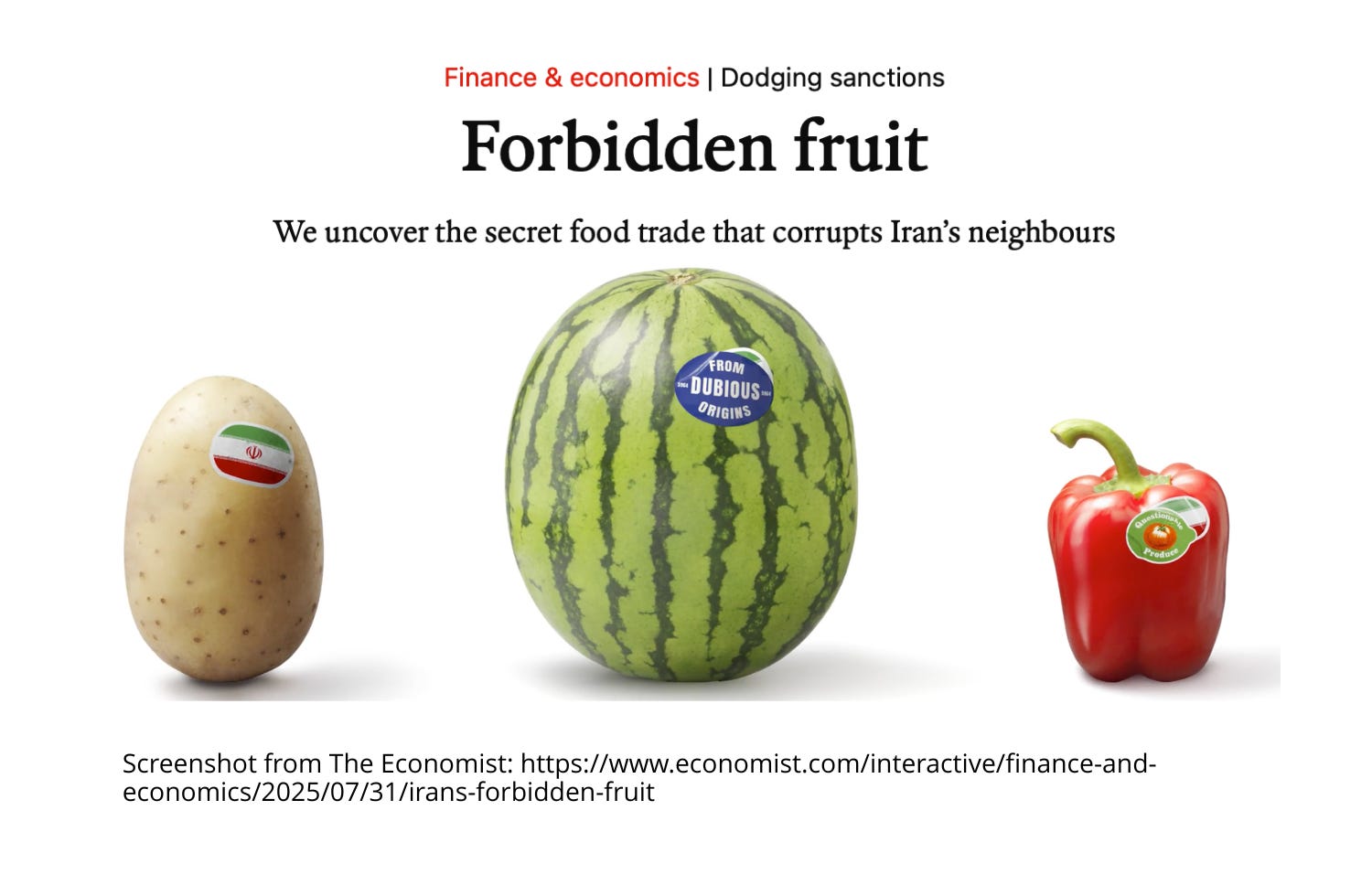
That very omission of a geographical, historically recognized name should tell you a lot about that investigation and why it didn’t fulfill the criteria of a journalistic piece meant to inform and enlighten. More legacy media organisations are embracing that omission when it comes to the naming of the body of water separating Iran from the Arabian Peninsula, and at some point, it stops being mere negligence or imprecision. Can we imagine a concerted effort aimed at progressively renaming the Indian Ocean into ‘the Ocean’?
Other terminologies are also being subtly twisted to knowingly or unknowingly further the hypothetical civilizational battle I just referenced. South Carolina Senator Lindsey Graham is only one of many prominent US public figures who’ve described the recent war on Iran as a “religious,” and “holy” conflict. At times, the misrepresentations can be focused on ideological, sectarian differences, villainizing Iran as a Shia holdout in a predominantly Sunni neighbourhood, and at other times, they can appear in the form of erasure and distortion of history.
Some people may perceive Iran as a monolithic society. Your thoughts on this?
This is a real issue, and the torrent of media propaganda campaigns can blind us to the fact that no country of this size and population, and no community for that matter, can be a monolith in which everyone thinks, behaves, dresses, worships, and believes the same.
This was not always the case even though the pre-1979 media portrayals of Iran weren’t universally congenial, either. [Background: The 1979 Iranian Revolution led to the fall of the Pahlavi dynasty and the establishment of the Islamic Republic.] But when there is a gigantic media and entertainment apparatus across the Anglophone world that rehearses the same platitudes about a nation of 90 million people for half a century, it is no wonder that generations of media consumers will develop ideas about that country that are more or less identical.
Just as the most hardline elements of Iran’s political establishment need perpetual enemies to rationalize their protectionism and isolationism, far-right collectives across North America and Western Europe also require a formidable cultural bogeyman to be able to market their fear-based policies and win elections based on them.
Are these ‘stock’ perceptions in a lot of the media also mostly due to lack of knowledge, distance from Iran, or other factors?
Of course, there is no way these uniform depictions can be ascribed to a single factor. In some cases, it’s merely a lack of knowledge that dominates the discourse when the recipients of information do not find the right channels to defy the stereotypes.
Sometimes, an author, a publication, or an Instagram page that is churning out eye-opening, essential materials about a subject remains undiscovered to us for so long. It’s not anyone’s fault that it is algorithm that decides what our information diet should look like.
Sometimes, a more systematic tendency thwarts debate, extinguishing diverse ideas. And at other times, it’s just lazy journalism that allows misinformation and disinformation to thrive, enabling cognitive dissonance to triumph.
Let’s remind ourselves that for years, reporting on Iran has been largely done by reporters who do not speak Persian, have not traveled to Iran, and in more extreme cases have not met Iranian citizens, either. So, it’s a very disconnected form of journalism that we’ve been acclimatized to.
Some say that since there are media restrictions in Iran, they find it hard to use or consume what they read from its media outlets, such as state news agencies whose information gets quoted in international news reports. How do these realities impact the information context and shape what audiences encounter today?
Of course, it has long been established that the Iranian government’s media policies have been toxic and obsolete. Its moratoriums on public access to the internet, its crackdowns on the press, its unfriendly relations with foreign correspondents who sporadically travel to the country, and its arbitrary persecution of local reporters have underpinned the spiraling of misinformation and the induction of a ‘gossip culture.’
In this idiosyncratic landscape, there are multiple sources, including tens of news websites, independent newspapers, social media pages, local VOD platforms, and state-run broadcasters competing with each other as well as with their international counterparts and diasporic news outlets. This is a confusing terrain for news consumers to navigate.
In a news ecosystem in which trust has been rapidly diminishing, journalism standards would take a hit. Add to this the government’s shutdown of multiple popular newspapers in recent years and its decision to eject major international broadcasters from the country at different times, which has projected Iran as an inhospitable, unwelcoming place for journalists.
Under these circumstances, media reporting of the country would become increasingly dependent on the unknown, reliable sources would become difficult to identify, and personal preferences come to play an outsized role in how events are recounted and details explained. These dynamics will have a bearing on who is quoted and who is discounted.
What advice can you give to those who want to know how to learn more about the flavour of conversations in Iran (from Iranians) without Western media framing, and about how Iranians tell stories? I know some people, for instance, who are followers of Iranian films.
To comprehend the complexities of Iranian society, we need to decide what we wish to decode. Clearly, the generic forms of reporting that are accessible in the mainstream media provide some degree of introduction: a country that is at odds with the West, a government that pursues a controversial nuclear programme and has a bleak human rights record, and a troubled economy that is beset by sanctions and bad governance.
But past a certain point, this is not introduction; rather, it’s indoctrination, because there is no way one of the oldest continuously sovereign states in the world can be described merely using three or four bullet points that have remained doggedly unchanged for decades.
Here, we can find solace in the availability of a large number of young Iranian artists, writers, and content producers who are going to great lengths to overcome repressive practices at home, navigate internet access impediments, and battle global isolation induced by the sanctions to share their message with the world.
And it is not just their voice that beams through their social media messaging. They also exhibit the different subcultures that exist within the Iranian plateau, reveal the lifestyles that distinguish the Gen Z and millennial Iranians from their predecessors, and offer rare glimpses into the literally unseen parts of Iran: bookstores, cafes, sports venues, theaters, concert halls, art galleries, and other social spaces that corporate media have not sought to spotlight.
These environments are places that the global audience cannot readily visualize. Imagery matters when it comes to the formation of perceptions and preconceptions, and the Iran that the world has come to see through media imagery is one of black-clad demonstrators chanting anti-US slogans, clerics delivering inflammatory sermons, and underground military sites.
How can these frames, which are admittedly part of the panorama, constitute the totality of the picture in a country three times the size of the state of Texas? Which is why watching celebrated Iranian movies clinching Academy Awards, Golden Globes and Cannes prizes, listening to traditional and modern Iranian music, and reading books by notable Iranian writers are some of the best modes of surveying the pulse of life in Iran.
Since the US and Israel began their attacks on Iran in February, what question around these do you get asked most often about Iran?
Of course, friends and colleagues here have been kind enough to regularly check in on me and ask if my family and friends in Iran are staying safe. This is the question that I find myself answering all the time, which is an indication of generosity and love that is extended by those I value and hold in high esteem.
Readers and those who interact with my readings mostly ask if the nuclear threat is exaggerated or real, if I expected the Iranian people to show such a resilient response in the face of foreign aggression, and if I believe the war has precipitated any democratic change in Iran.
Others have also asked me about the erratic behavior of some segments of the Iranian diaspora and their support for the Israeli regime. This is something I’m trying to scrutinize more deeply given Israel’s deplorable record of human rights violations in Palestine and its leadership’s lack of respect for civilian life in Iran and elsewhere in the Middle East.
What is one thing that news users and outsiders do not know or misunderstand about Iran that you’d like them to know?
I find it a difficult question to answer given the magnitude of misperceptions that have been entrenched in our collective psyche. I’d generally invite the readers to familiarize themselves with the facts of Iran as a country that inherits an ancient civilization and has offered to the world many artefacts of knowledge and modern life that are the products of the ingenuity of its people; a country that has not been a faithful guardian of that historic legacy in recent times.
Like every other place, there is good, bad and ugly in Iran. There’s an ongoing clash between the government and its people over what the two sides misunderstand or don’t understand about each other. There is a wide range of reforms that Iranian people have been demanding for years, and which they’ve bravely fought to achieve.
One thing I’d like to highlight as a distinctive feature of Iran is that in the face of injustice, disparities or bad governance, its people are the first ones to rise up and raise their voice. If the Iranian government engages in bad behaviour, inflicts harm on other nations, promotes radical ideologies, mistreats women, and supports autocrats elsewhere in the world, Iranians take the lead in challenging these policies.
It’s a heterogenous society that contains within itself an array of religious, ideological, political, and cultural differences. Most Iranians are not ever happy to become vehicles of repression and authoritarianism, and you won’t find them justifying whatever their government does in the name of patriotism. Which is why some of the distinguished scholars of humanities and social sciences hail from Iran.
I have not seen a tendency among Iranians to confront criticism of the Iranian government, even if it’s harshly-worded, incendiary, and even derogatory, by accusing the speaker of being Islamophobic or bigoted. Excluding the traditionalist supporters of the theocracy, Iranians are remarkably open-minded, at least when it comes to critically debating their government, and I have not seen this attitude in other populations in the region.
How does it feel to see the attacks by the US and Israel back home?
The world didn’t need this unprovoked war of choice. The world is not a better or safer place as a result of nearly 40 days of bombing in which the United States and the Israeli regime unleashed some of their most advanced weaponry on Iranian civilians, causing unprecedented destruction and loss of life. [Note: this interview was done just before the Israel and Iran traded attacks, and the US attacks on Iran on 9 June, two months after a supposed ceasefire.]
History books will not be kind to the warmongers who waged this war and, in the process, invoked apocalyptic rhetoric to demean the Iranian civilization, even translating their threats into action by bombing Iran’s cultural landmarks, UNESCO World Heritage Sites, universities and prestigious research centres. . . .
What this war has left behind is global economic mayhem, the reinforcement of conservatism in Iran, and the intensification of anti-Western attitudes that will haunt the Iranian imagination for the foreseeable future. A generation of Iranians will remember more than 120 schoolgirls who were killed in Minab on the first day of the war, classrooms, hospitals, and homes that were bombed across the country, and neighbours and world powers that didn’t stand by them in their most difficult hour.
What kind of newspaper would you like to see in Iran one day? What would it look like?
I hope to see an independent Iranian newspaper that is not routinely harassed by the authorities, and one that is not meant to receive instructions from the government on what it can and what it cannot publish.
Although it’s simply a fantasy at this point, I hope to see such a newsroom staffed by Iranian reporters who have received training at prestigious global journalism education institutions and who are given the freedom to interview whoever they wish, including American politicians and public figures, furthering a dialogue to bridge the gaps between the two nations.
Clearly, a newsroom that is not at the mercy of power and only answers to its constituents should be empowered to investigate corruption, expose wrongdoing, and tell the stories of people who have endured injustice and discrimination, and do so without euphemisms.
I am not sure if Iran will have such a newspaper soon. There have been publications that have done unapologetic journalism in the past, and they were banned. Even today, there are magazines and independent newspapers that are doing very good journalism, even though they’re still a far cry from the highest standards.
Yet, Iran is not an easily predictable country, so let’s hope we’ll see more avant-garde forms of Iranian journalism in the future.
(Next in Part 2 - a list of Iranian sources of news and commentary that Kourosh drew up for those curious about these.
***
(*The online meeting with Kourosh on 23 May 2026 was hosted by the NHK Broadcasting Culture Research Institute, The University of Tokyo Interfaculty Initiative in Information Studies, and Waseda University Institute for the Next Generation of Journalism and Media.)
Iran is denied its diversity and complexity, this post admits, behind a veneer of tired but persistent stereotypes and tropes.