

IN APRIL, a number of us held a Zoom conversation* about the US-Israel war on Iran – a space to take in our unrestful world from where we sit in Southeast Asia.
I started off by polling the 18 attendees: In your view, who’s winning the war?
A. Iran
B. USA
C. I’m not sure/don’t really know.
Thirty-eight percent said ‘Iran’, and no one replied the US. Not bad, I thought, since the group came from mixed backgrounds and only one or two were journalists like me, more likely to follow the news cycle more closely.
The main takeaway? Majority (62%) said they weren’t sure how things were going.
This highlighted how, in the US-Israel war on Iran, it has become almost a full-time job to make one’s way through the competing torrents of news, video clips and insights rushing at us.
These are everywhere, 24/7. But what do we dive into, scroll by or use just for information? How do we decide what to invest our attention in?
There’s propaganda, but it’s about much more than that. There are social media, algorithms and deepfakes — but it’s not just about tech or platform issues. It also isn’t just about “the facts”. Facts, figures, quotes can be accurate, in stories with solid language and catchy headlines.
But the stories that hold them can be loaded with assumptions and worldviews that shape what audiences see - or don’t.
A common example is the mainstream media’s default of carrying more voices from the political West, which is their home context and their starting point for telling stories. These voices get major billing in headlines and often occupy most of the space (literally, number of paragraphs) in a story, while other actors are more of afterthoughts and/or devoid of nuance, or are unstable characters little more than caricatures.
Such story lenses feel much more hierarchical, rather than horizontal and expansive.
So - because there are real differences among news brands, your choices as a news user are a serious matter.
This is even more so at a time when - especially since Israel’s genocidal attacks on Gaza in 2023 - the ‘western mainstream and corporate media’ (at times called ‘mainstream media’, ‘western media’ or just ‘CNN, BBC or the New York Times’) have been under fire for reporting that is less than professional and honest, including the use of double standards when it comes to the non-Western world, tiptoeing around Israel and giving much more space to its perspectives than to Palestinian or other views.
It’s important to share a few examples for context.
In 2024, a leaked New York Times memo on the coverage of Gaza instructed reporters to avoid the use of “genocide”, “occupied territory” to describe Palestinian land. As for “Palestine”, they were told to avoid using it in stories except in “very rare cases”. In December 2024, Drop Site News ran ‘The Civil War Over Gaza’, which looked into the “extensive bias” in the BBC’s coverage of Israel’s genocidal war on Gaza and how some protesting journalists called for a review of editorial standards.
There are data analyses too, such as ‘Framing Gaza: A Comparative Analysis of Media Bias in 8 Western Media Outlets and ‘How UK Media Covers the Gaza Genocide’ (April 2026). Just out is ‘We Analyzed Thousands of News Articles: Here’s the Proof of Pro-Israel Bias in Mainstream Media’ by The Intercept (12 May 2026).
In March, the UN special rapporteur on the human rights situation in the occupied Palestinian territories, Francesca Albanese, called for public input for her study into killings and rights violations against Palestinian journalists and “the role of Israeli and international media in reporting events in the occupied Palestinian territory after 7 October”. (The unease about media framing weaves its way into everyday settings too, not least in in razor-sharp stand-up comedy like that done by the Egyptian American comedian Bassem Youssef.)
The drip-drip shaping of perceptions can come through what’s in a news account, but also from what’s not in it. News sovereignty is a survival skill in the midst of today’s actual wars and the war for our attention.
‘Consume - but don’t swallow too quickly’. That’s the advice that I, as a journalist and editor for four decades, shared in the Zoom session described at the start of this piece.
There are of course poorly done information by groups on different sides of the war, including those that various audiences may agree with - but here I discuss news consumption in a market that is dominated by the big networks, and where there is a huge need for knowledge about, and use of, other media products.
Below are five tips for navigating the news in a world that feels like a cauldron, one where wars are boiling up one after another, and we ask if we are already in a world war. The examples below are around Iran, but also about Palestine and Lebanon as they are all part of the same larger story.
1 Vary your news and information sources - and start by bringing non-Western news outlets into your radar.
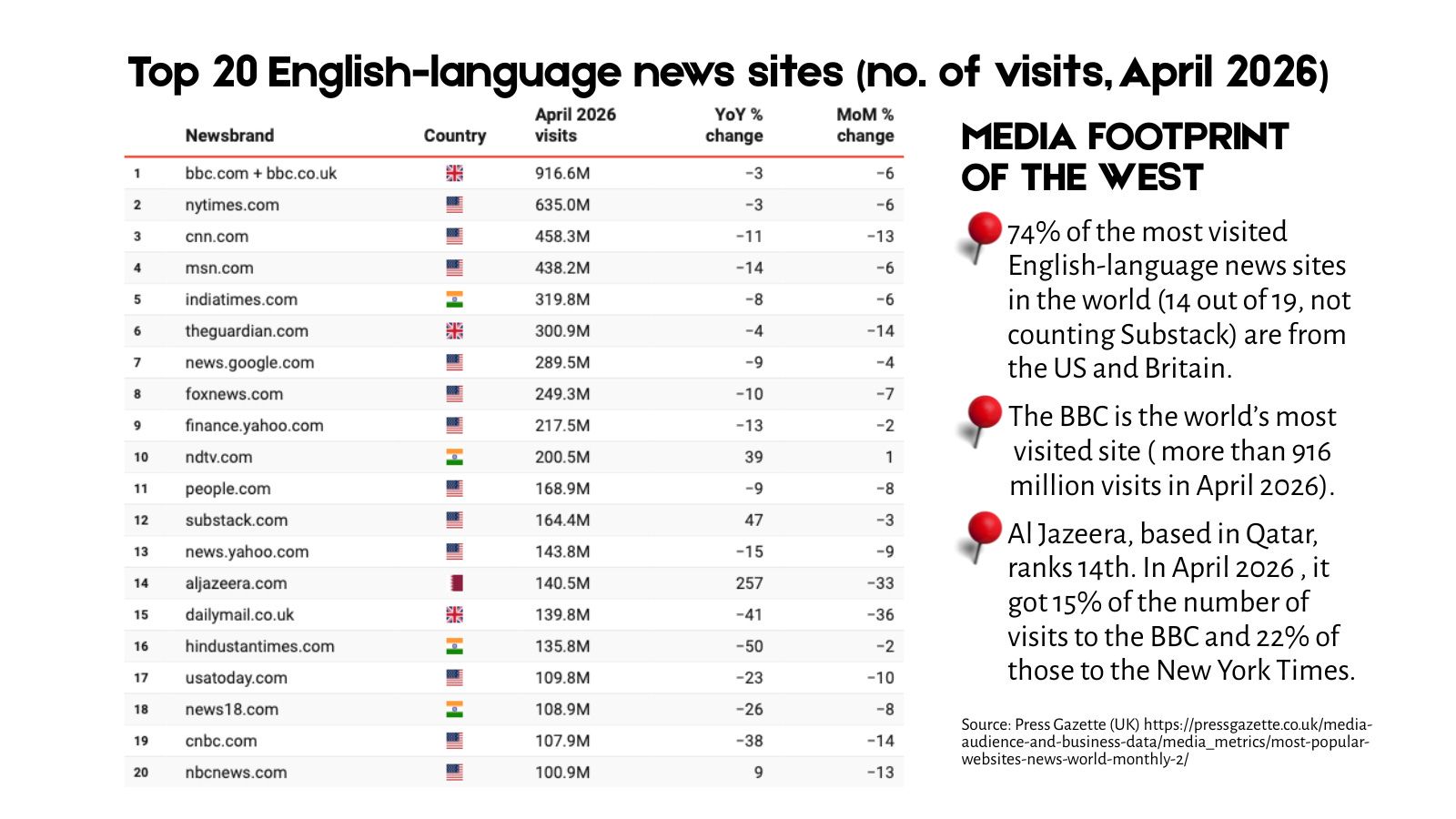
Why non-Western news? Because Western, mainly American and British, media outlets have an oversized footprint in the world’s news spaces. (The BBC is the most visited English-language online news site in the world, shown below.)
To see the much wider news world out there, avoid getting stuck in the orbit of the western-oriented news world.
Consuming the usual news choices - if you’re reading the New York Times, BBC, The Guardian, Washington Post and little else - means looking through a lens tethered to the world and flavour of the West. Adding the BBC to the New York Times does not really add much diversity, as it’s from the same news species. The reach of the big western media may be global, but the perspectives it reflects are not necessarily so.
Bring in something that adds more value (and spice) to the news you spend time on.
From among US news choices, you can follow independent media like Drop Site news. For international news, go too to Al Jazeera, which shows more of the rest of the world.
Cast a wider net, with critical eyes. Seek out perspectives from Iran given the deficit of these in the mainstream media. Same with Lebanon, other West Asian countries. Listen to analysts and officials from there speak for themselves. Pakistan is a mediator in the war on Iran? Check out their media (such as the Dawn) as well.
2 Mix up your news menu to include various formats and types of stories. Short, hard news pieces tell you what just happened, but longer stories, video features and podcasts immerse you in what they mean.
Many people read international news in their national newspapers or news sites, usually event-based news from wire services like the Associated Press, Agence France-Presse or Reuters. These are snapshots, not quite full-framed stories.
For the bigger picture, seek out long-form text features, podcasts or documentaries. These go into ‘why’, ‘what does this mean?’, ‘what’s the history of this’ or ‘what now?’. They help unpack issues such as why Gulf countries have differing positions on the attacks on Iran, or what Tehran means by protecting its “sovereignty”.
For some people, listening to podcasts slows down the assault of daily news. Learning the backstories behind the headlines may help you process the news.
You may also find that key issues can get discussed in other news places before they get to the mainstream media.
For example, I heard analysis about the massive, perhaps irreparable, damage that Iranian strikes caused on US bases and facilities in the Gulf being discussed in podcasts many weeks ago. These made headlines as “exclusives” and similar investigations in mainstream US outlets only in late April and May. The Wall Street Journal ran its story on 26 March, NBC on 25 April. CNN had its version on 1 May, the Washington Post on 6 May and the New York Times on 8 May.
These types of outlets did not have much informed description of Iran’s political decision-making processes under its constitution, its decentralized military response systems, why it calls the 28 February military attacks the “Third Imposed War” or even the nightly demonstrations in Tehran soon after the US-Israeli bombardments started. But users of podcasts, Substacks and other independent media knew about these.
3 Read news outlets that carry different views, including those you may not agree with. Doing so brings the wider conversation, not just one aspect of it, to you.
Flex your curiosity muscle when reading or watching news, led by the need to understand - rather than the desire to be affirmed or a need to agree or disagree.
Going by whether a news site is on the left or right is but one input. ‘Pro-Iran’ or ‘pro-US’ isn’t the whole point too - it’s about finding storytelling that helps you better take in the various elements of an issue and see how the many other sides see it.
As for the western mainstream media, read them as a way of keeping up with the news. But stay aware that they provide far from the whole story, often struggling to see beyond stereotypes or western framing about West Asia (and the Global South).
Use them for what they do best - their capacity to break important stories and their rigorous editorial processes, their being a barometer of dominant narratives that other media then pick up as well.
An example is the New York Times’ exclusive on how Israel sold the attack on Iran to Trump (7 April 2026), which discusses an angle of the war that is of huge interest to domestic US audiences. Beyond looking at what’s in major stories like this, commentators often read such pieces as a sign of what ‘even’ the elite media are reporting, for instance that Trump’s war on Iran has become a quagmire. Publication in these big outlets is also often valued as their confirming something that other independent media and local sources have been saying - at times for years.
On ‘The Katie Halper Show’ in April, US historian Norman Finkelstein said that “the normal mouthpieces for Israel, like the New York Times” want Trump to lose because they think he’s “a disaster”. He added (10:50 in the video below): “So if they have to choose Trump losing with Israel losing, they’ll choose that. That’s unprecedented - unprecedented, what’s happening now.”
Another example. On 12 May, the Wall Street Journal had an exclusive report that the UAE has launched military strikes on Iran - showing that the Gulf state is an active combatant in the war. On the same day, the paper published its own position in an editorial that said Iran’s demands to the US were “unserious”. It carried a video where an analyst says he agrees with Trump that the US is “winning” the war.
It’s not that all the stories in a western outlet have the handicaps described above, all the time and everywhere. Some stories are better than others in the same publication, including those that carry the same bylines, and even on the same topic, page and day.
These can all be true at the same time. Audiences, therefore, need to do the work - and knowing where these news products are coming from is a compass you’ll find handy.
4 Build your own news playlist. Make it the result of mindful choices, and avoid being led only by what the algorithms hurl at you.
We all stumble upon good sources from social media. But their algorithms show us more of whatever we read, liked, got mad over, and these feel overly pushy over time.
So while most people do get their news through social media, I suggest going beyond them and checking out the websites of the media, their reporters, analysts. Why? You can read, watch in peace directly on news websites, without other posts distracting you.
Two cool things about podcasts. First, some interesting ones bring the same guest analysts back regularly, even weekly, allowing audiences to follow the wider arc of the war on Iran and other stories. Second, you can listen to interviewers and guests without filters.
5 Watch out for some red flags. Do some of your own sleuthing when reading, watching news.
Here are just a few examples of what to be wary about in mainstream news stories around the war on Iran:
giving much more weight to the US President and Western voices and views, putting the Iranian side much further down (often much more briefly, with fewer or no quotations) in the story
Iranian officials and commentators’ views and statements are all out there on social media, websites, some podcasts. Yet there is lopsided attention to what the US says or does, and much less about Iran, reporting from there or views from its analysts and other people.
It’s like this: If the war story was a theatre performance, some in the cast of characters have been missing or appear as extras when they should have starring roles.
A sample of these Iranian perspectives are those from the University of Tehran’s Hassan Ahmadian, who told the Middle East Eye (below): “Even a war, for Iran, is better than caving in to what Trump and (Israeli Prime Minister) Netanyahu want.”
Iran’s policy has been to be “neither east nor west - we are independent”, he explained. For it, he continued (at 18:33), the US’ demands, including those that would result in the US managing Iran’s oil like how today’s Iraq requests the US Treasury for access to its own funds, are “unacceptable for any sovereign nation”.
failing to say that the war began with the 28 February attacks by US and Israel on Iran
The phrase “Iranian aggression” has been used as ‘fact’ in stories. But this allows space for the framing of Iran as the aggressor when it launches retaliatory attacks, a portrayal that parallels the framing by some governments in West Asia and in the West. (The Cambridge English Dictionary defines ‘aggressor’ as “a person or country that starts an argument, fight, or war by attacking first”.)
calling the war on Iran “a campaign” or an “operation”, when it is a full-fledged war with massive aerial bombardments
This is not so different from calling Israel’s invasion of southern Lebanon an “incursion”.
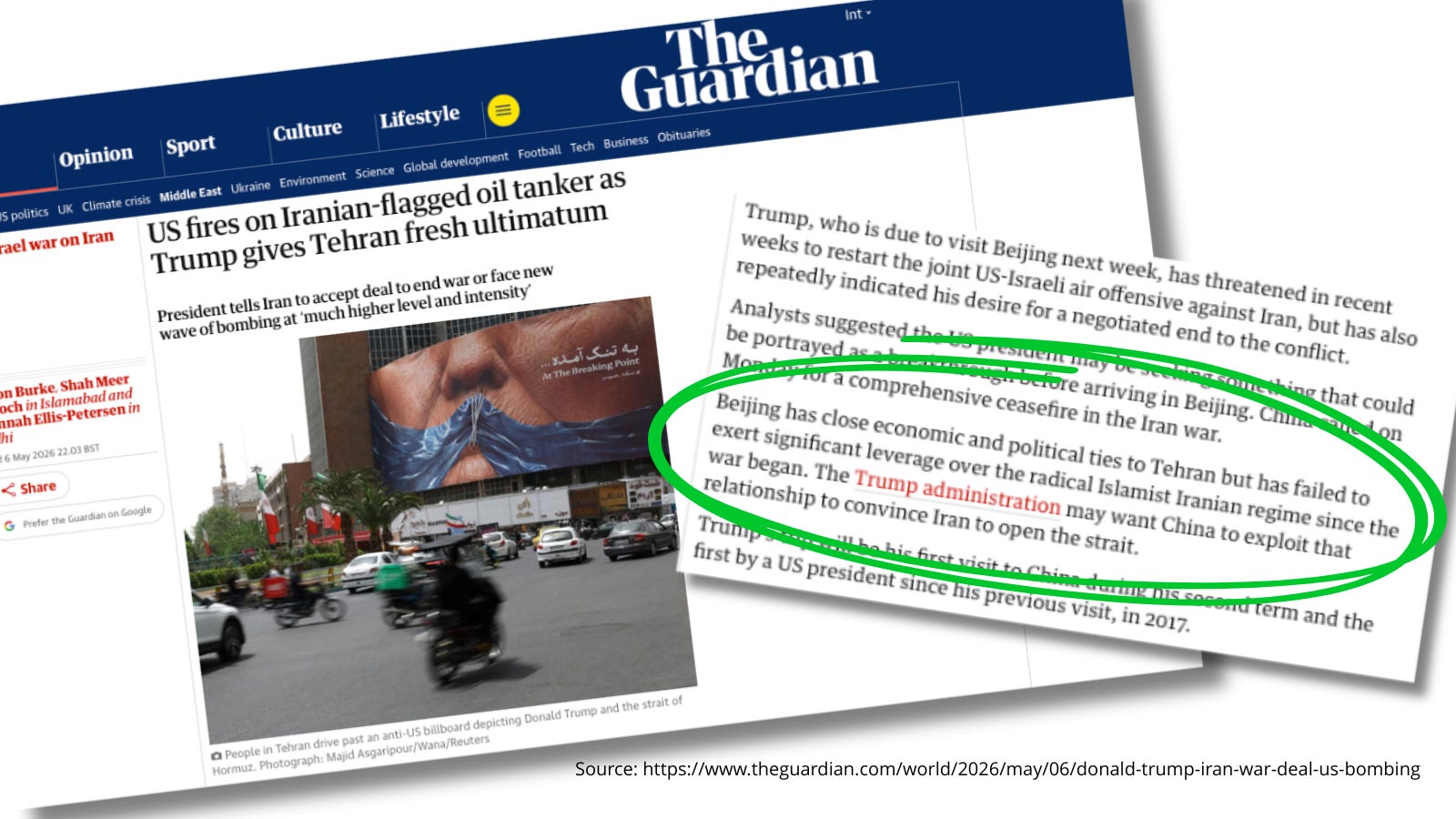
using easy-to-use labels for Iran, such as the use in a Guardian news article on 6 May of “the radical Islamist Iranian regime” as ‘fact’ (see below). More accurately, Iran is “the Islamic republic”.
Another example - we often read the phrase “Iranian proxies” used to describe Hezbollah in Lebanon and Yemen’s Ansar Allah (that’s the name of what outsiders call ‘the Houthis’) across much of the Western media. Many other media elsewhere copy this practice as well. But these groups are not “identical extensions of the Iranian state”, and “each has its own leadership, domestic agenda and military capabilities”, Gulf News explained.
There are more accurate and informative ways to tell audiences who they are, for example explaining that Hezbollah is a political party, with an armed group, that was formed to fight Israel after it invaded Lebanon in 1982. See how former UN human rights official Craig Mokhiber explains “proxies” here.
packaging conclusions as fact, when they (at the very least) need to be sourced and explained
In the same example above, The Guardian presents as ‘background’ the sentence that China “has failed to exert significant leverage over the radical Islamist Iranian regime since the war began”. This is more of an interpretation and conclusion, not to mention one whose basis would draw questions. (I cite examples from The Guardian since I read it daily.)
consistent, habitual reporting heavily based on anonymous sources
Using anonymous sources can be part of a solid, path-breaking expose. But sit up if is a habit, involves the same style or topics, or is used regularly by the same reporter or news outlet. This approach can also be a way to plant or feed a narrative into the news cycle.
In the next post, I’ll share a list of news outlets that are worth considering for inclusion in your news menu. Thank you - and every subscription is valuable.
*A footnote on the Zoom discussion I talked about: It came around as a result of the fact that friends and colleagues have been asking me what to read to better understand what’s happening in West Asia. The Manila-based Probe Media Foundation Inc hosted the conversation. As a journalist, I couldn’t not follow Gaza, West Asia and related geopolitical issues. Nowhere in the world is far away from the unbearable things we read and see.