

‘Don’t just follow the pack.’ Journalists like us go by this tenet - and it’s a useful tip too for news consumers in the war for our attention. In my first post on 16 May, I made a pitch for building news sovereignty by bringing in diverse news products and avoiding getting stuck in the orbit of western, corporate mainstream media that reaches everyone, everywhere.
Below are 12 useful news, analysis and magazine (English-language) websites that I check, read and consume regularly - around issues related to the US-Israel war on Iran, West Asia, geopolitics and power. Take this as a recommended news playlist of sorts, offering products to explore.
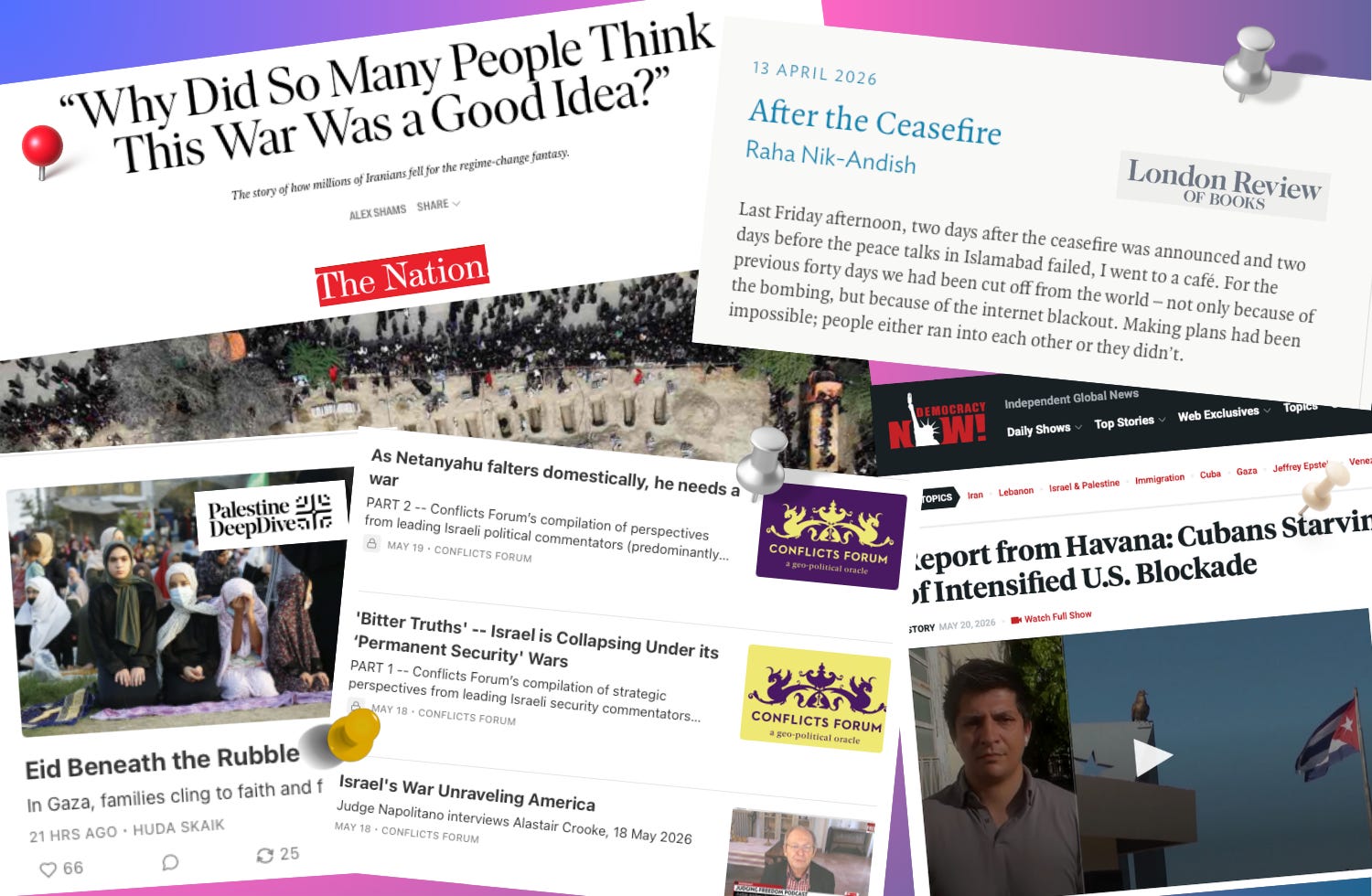
The items listed below have one or more of these characteristics: they have quality writing and storytelling, offer views that are not always seen or heard in mainstream news spaces (or are often the subject of stereotypes and unidimensional reporting), are from within West Asia and/or show us insights from within it, produce interesting material about West Asia and/or the developing world, and tell audiences about geopolitics, power and life on the many other sides of this world.
I also put together this playlist using two criteria. One, these are worth your time. Two, they will widen your the world and complement your other sources, including mainstream media products you use.
I’ve also scribbled notes, shared links and visuals here and there. Items are arranged in no particular order. I don’t include personal newsletters, blogs or channels (there are many worthwhile ones that can come later). Excluded are the big media, including Al Jazeera, which more people likely already know about.
It has had consistent coverage of, among others, the warrants issued by the International Criminal Court against Israel’s Benjamin Netanyahu and others, and the subsequent harassment and other actions against ICC prosecutor Karim Khan. Check out ‘Power Cannot Silence Law’, an interview with Khan (8 May).
The op-eds by its editor-in-chief David Hearst (also as video clips) are worth a follow, and his latest one (25 May) is ‘Iran has won the war. Trump and Netanyahu now face a reckoning’.
2 New Arab
‘New Arab’ focuses on West Asia, North Africa and more. In April, it ran this video opinion piece with Palestinian activist, doctor and academic Ghada Karmi for Nakba Day, entitled ‘I was there during Nakba. It didn’t start in 1948’.
Karmi’s story is similar to that of other Palestinians who had leave their homes amid attacks by Zionist militia, but you may have come across the twists in her story somewhere online. Above her family home in Jerusalem (occupied by Israelis), an additional floor was added and was purchased by the ‘New York Times’ in the eighties for the use of its bureau chief in Israel, news reports have said. Some background is in this article and here.
This magazine’s name is taken from the international calling code for what its editorial team calls ‘Israel-Palestine’.
I remember +972 for April 2024 exclusive on the Israeli army’s use of AI to identify and bomb targets in Gaza. That big story by Yuval Abraham (‘Lavender: The AI machine directing Israel’s bombing spree in Gaza’) remains among the magazine’s most-read articles today.
This respected Israel-based newspaper has journalists like Amira Hass (veteran correspondent who has lived in Gaza and the Occupied Palestinian Territories) and Gideon Levy, journalist and author we hear in various interviews and podcasts.
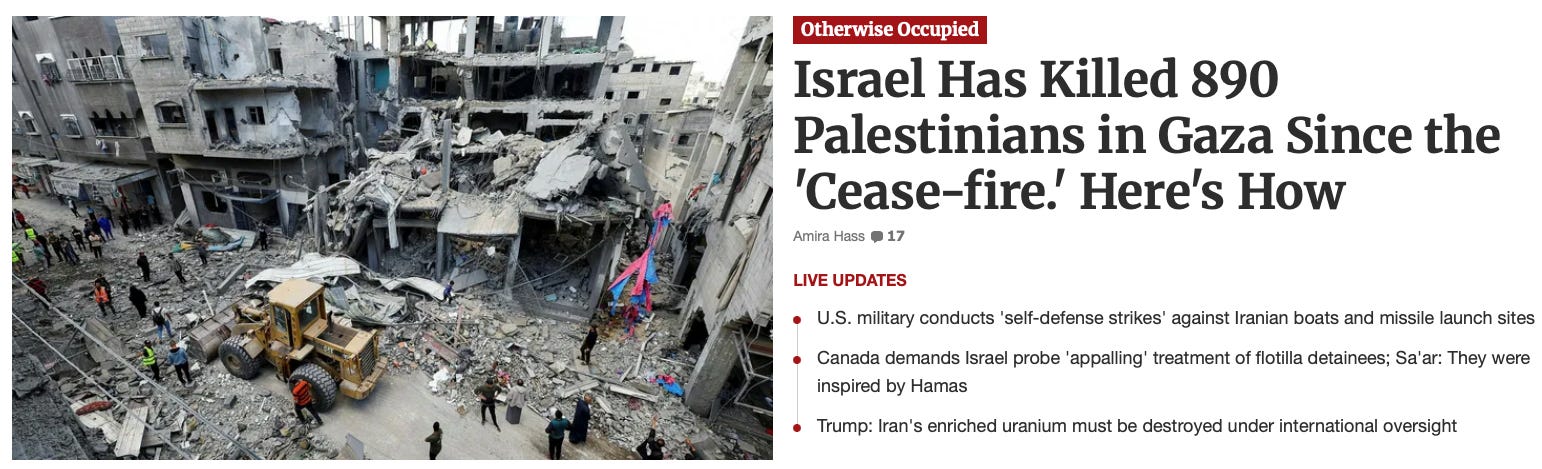
’Survival outside Gaza was a lie’, written by journalist Abubaker Abed, stood out for its honesty. His tone in this piece, done a year after he left Gaza, contrasts sharply with how he sounded, uncertain but still hopeful, in his writings soon after leaving home.
Now, he has experienced life in the West. He writes about the irony of being told to be careful with his words about Gaza and Palestine in Ireland, where he now lives, and in places he travels to – when he was able to speak his mind while in Gaza. He’s physically safe, but shackled in other ways, and always uprooted.
Abed writes, “I have been emotionally dead, which has also physically devastated me. Survival is never only physical. Freedom is also not wholly a physical condition. It is also mental. In Gaza, death may have been raining on me, but I felt like a true survivor — my mind was not colonised. In exile, I am now fighting for the dignity and freedom of my mind more than anything”.
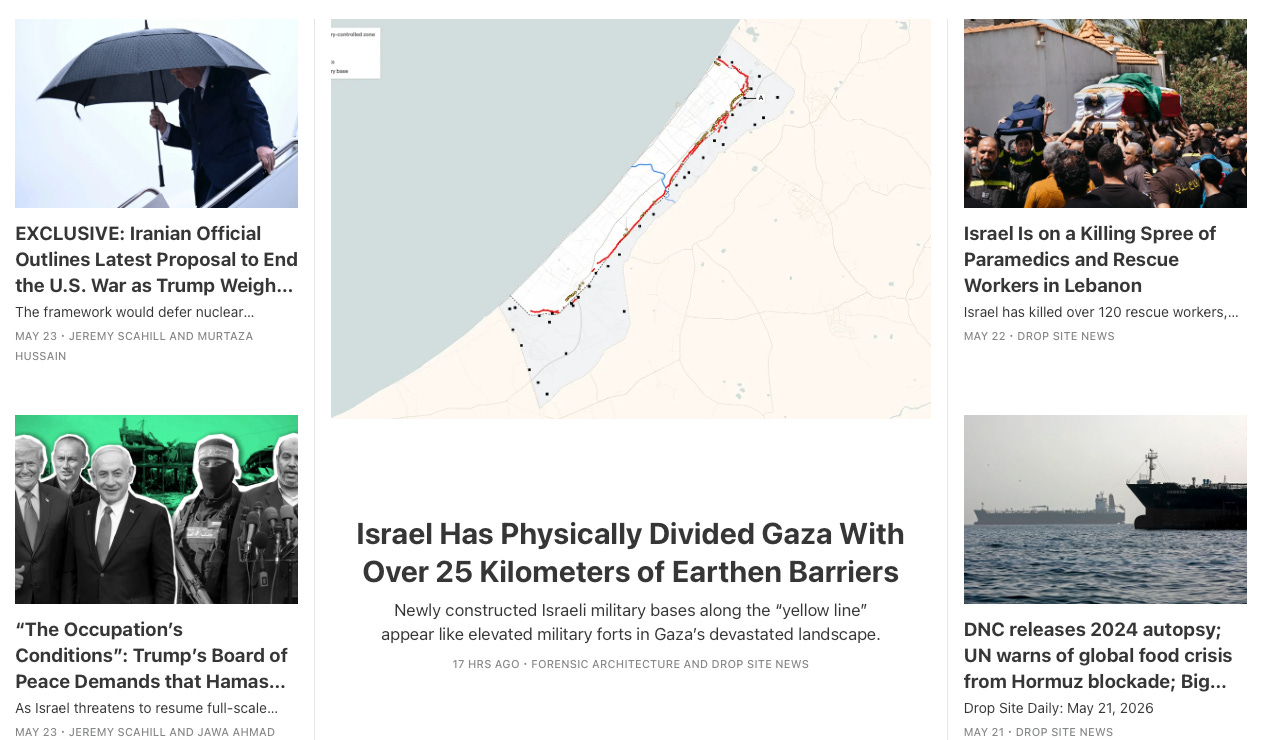
Topnotch investigative reporting, with material not found in the usual US mainstream outlets. Below is its front page on 26 May, with a data investigation story on Gaza today, a ‘strip’ that is now a sliver, in collaboration with Forensic Architecture.
7 Zeteo
In his 27 May column in ‘Zeteo’, its founder and editor-in-chief Mehdi Hasan goes into context that explains how the war on Iran and US’ interference in West Asia is far from just a Trump predilection. The US supported Iraq to undermine Iran, and later turned its at-the-time useful ally into its a useful enemy. Mehdi concludes: “Americans have short memories and never seem to learn from history.”
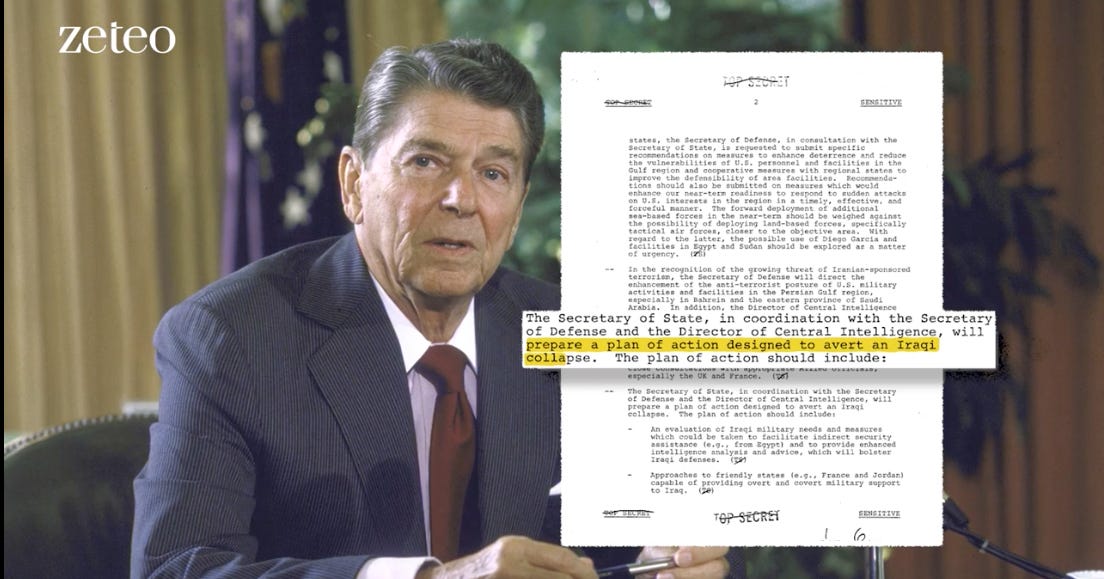
Here are more reminders about US interference in West Asia, which I’ve come upon: In this clip (at 00:24) from the Katie Halper Show, then Democratic US presidential candidate (and later Secretary of State) Hillary Clinton told France24 in 2007: “… the Iranians to know that if I’m president, we will attack Iran. Whatever stage of development they might be, in their nuclear weapons programme, in the next ten years, during which they might foolishly consider launching a nuclear attack on Israel, we will be able to totally obliterate them. That’s a terrible thing to say, but those people who run Iran need to understand that. . . .”
There is a “sameness” across US foreign policy across administrations, whether Republican or Democrat, Drop Site News co-founder Jeremy Scahill told Al Jazeera. “People make themselves feel like they’re on the right side of history because they’re opposed to Donald Trump. But you can’t be a vegetarian between meals...if you don’t have the honesty or integrity to recognise the sameness… that exists between the Democrats and the Republicans, you can’t have an honest discussion.”
Former President Barack Obama did not press for accountability by his predecessor George W Bush, after 9/11, he continued. Said Scahill: “The failure to hold those war criminals from the Bush era … set the stage so that the Gaza genocide can happen, so that the crimes that the Trump Administration is [sic] committing can happen.”
This magazine, like the next one on this list, lets me sink into the issues usually covered as fast-paced news, often without much framing, colour and feel.
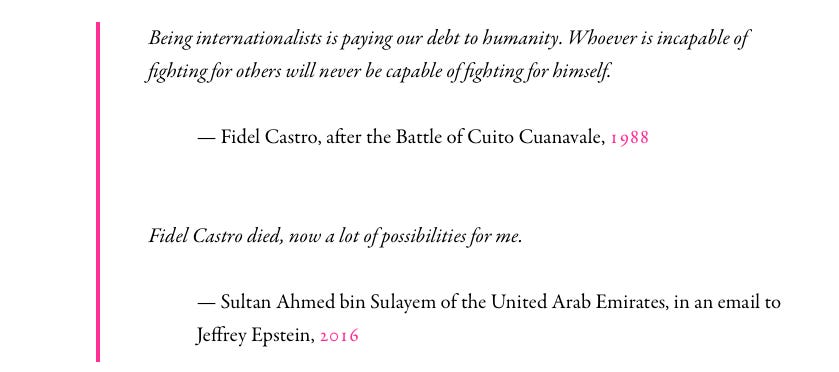
This is a story worth your time: ‘Four Days in Havana, Under Siege’ by Alex Skopic. “We wanted to see, firsthand, what it’s like for people to live under the most severe of U.S. sanctions. More than that, we wanted to see one of the only communist-governed nations on Earth, and report back about it, clear of the haze of propaganda that has surrounded Cuba for so long. And we wanted, in whatever small way we could, to help. So we got on a plane to Havana, armed with just enough optimism to think we might make a difference. This is what we found.”
The article starts this way:
There is also journalist Rania Khalek’s account from southern Lebanon in the current invasion by Israel: “The Situation on the Ground Here is Horrific”.
Soon after the US-Israel bombardment of Iran began, I read ‘The dry and the wet burn together’ on the LRB blog. ‘After the ceasefire’, published in April, brought me into the cafe along with the writer, Raha Nik-Andish. The same writer’s mood piece in May ( ‘Something Broken or Not at All’) uses the daily challenges of life to make readers feel how “instability has become a permanent condition” in Iran.
This short piece (‘Volleyball on the Beach’) by Gaza-based writer Hassan Ayman Herzallah says so much more than statistics can about those who have lost limbs from Israel’s genocidal attacks and atrocities.
We read in the news about Somaliland, much of whose recent ‘fame’ was brought about by its recognition by Israel in 2025. But Farah Bakaari’s ‘Sovereignty’s End and Beginning’ brings us beyond the confines of daily news and its profile of a community drawn into the conflicts across West Asia. “In Somaliland, the pursuit of statehood has come with a bitter irony,” the story goes.
The Review’s Spring 2026 issue (‘Forever Wars’) carries dispatches from Iran, Lebanon, Iraq, Israel-occupied West Bank, Ukraine (even a piece on Vietnam). It features an April 2026 roundtable on ‘The War on Iran’ here. (Scholars of Iranian politics, history, and culture are in this discussion.) Its Substack is here.
North South Notes, a “mini global affairs” magazine, caught my eye for its uncommon, outstanding story on Bahrain, which in the news as part of the war on Iran and as host of the US’ Fifth Fleet. (It thus got its share of retaliatory attacks from Tehran).
Read ‘The View from Bahrain’ by Kareema Abbas and Aamer (using pseudonyms).
Weeks ago I watched this Drop Site News interview with a Bahraini rights campaigner who talked about the Gulf state’s politics, distrust of Shia Muslims (including among its own people) and political prisoners. (Iran is predominantly Shia Muslim. I didn’t know, till I read up, that Bahrain was ruled by Persian empires in the past and that Iran at one point had, and gave up, territorial claim over it. The former British protectorate became independent just in 1971.)
+ SPECIAL MENTION:
12 Conflicts Forum - A Geopolitical Oracle
While it’s not a news or magazine site, Conflicts Forum is a must-follow resource that’s useful for making sense of the news around West Asia and the world today. It’s also rich in solid information that helps connect the dots across wars and tension points across the world.
This site carries regular incisive commentaries by Alastair Crooke, a former British diplomat whose independent, solid insights on Iran are followed by many. He also speaks in various podcasts.
Of value is Conflicts Forum’s translations of perspectives by commentators from Israel (here on 19 May), Iran (13 May), Lebanon and other places in West Asia (17 April). The material from Israel is especially useful, since conversations in the Hebrew-language press are often quite different from those in English-language news.
Must-add picks: From US media, there is also The Nation and Democracy Now! which also cover international issues. Read ‘Why Did So Many People Think This War Was a Good Idea?’ in The Nation.